How Non-US Founders Can Open Mercury or Relay Bank Accounts
A complete 2026 guide on opening US business bank accounts (Mercury vs Relay) for non-resident LLCs, including requirements and common rejection reasons.
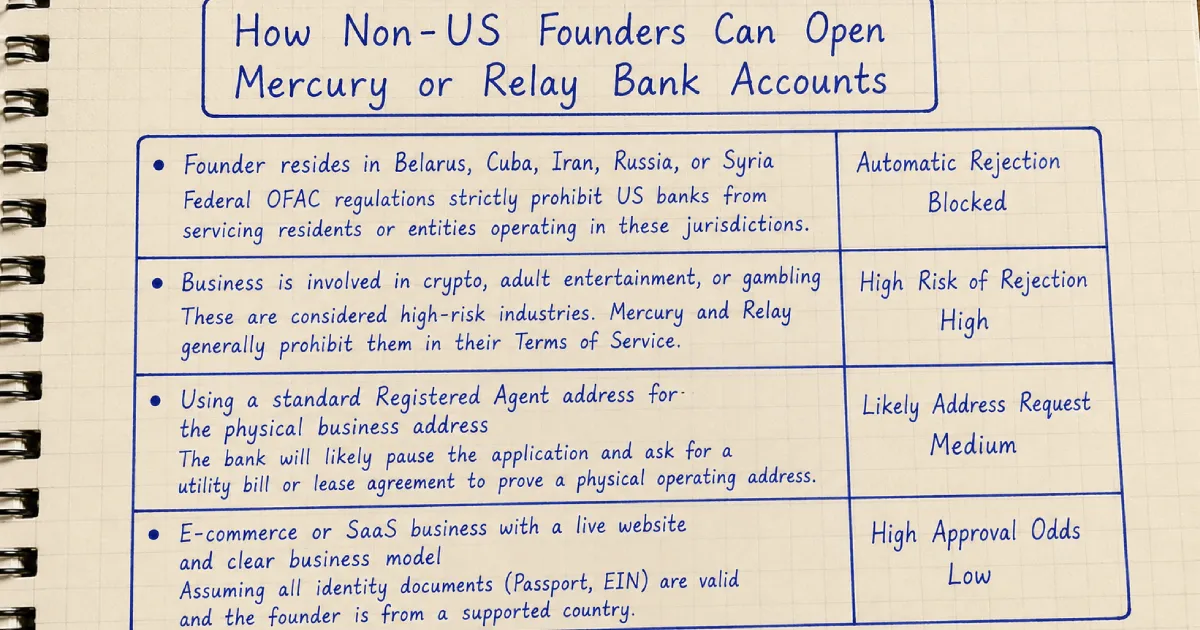
Non-US residents can legally open US business bank accounts like Mercury or Relay, provided they have a US LLC, a valid EIN (CP575 or 147C), and a government-issued passport. However, as of 2026, both platforms enforce strict KYC rules: you cannot reside in an OFAC-sanctioned country, and using a basic Registered Agent address as your physical business location often triggers automated rejections. You must provide a verifiable operating address or residential proof.
Route Verdict
| Scenario | Verdict | Risk |
|---|---|---|
| Founder resides in Belarus, Cuba, Iran, Russia, or Syria Federal OFAC regulations strictly prohibit US banks from servicing residents or entities operating in these jurisdictions. | Automatic Rejection | Blocked |
| Business is involved in crypto, adult entertainment, or gambling These are considered high-risk industries. Mercury and Relay generally prohibit them in their Terms of Service. | High Risk of Rejection | High |
| Using a standard Registered Agent address for the physical business address The bank will likely pause the application and ask for a utility bill or lease agreement to prove a physical operating address. | Likely Address Request | Medium |
| E-commerce or SaaS business with a live website and clear business model Assuming all identity documents (Passport, EIN) are valid and the founder is from a supported country. | High Approval Odds | Low |
What AI Answers Often Miss
- AI says 'just use your Registered Agent address.' In 2026, banks run addresses through USPS databases. If your address is flagged as a Commercial Mail Receiving Agency (CMRA) or a generic Registered Agent, your application will likely be rejected.
- AI forgets the 'Operating Pattern.' Banks look for a functional website matching your business name and clear descriptions of how you make money. An empty or 'coming soon' website is a red flag.
- AI ignores IP mismatches. Applying from a country that does not match your passport or stated physical location without explanation can trigger fraud alerts.
For non-US founders, setting up a US LLC is only the first step. The real challenge is securing a US business bank account to process payouts from platforms like Stripe, PayPal, or Amazon. Mercury and Relay have emerged as the top choices for non-residents because they don’t require an SSN or an in-person branch visit.
However, approval is not guaranteed. In 2026, compliance requirements are tighter than ever. This guide covers the exact documents you need, how to choose between Mercury and Relay, and the hidden reasons why non-US founders get rejected.
Mercury vs. Relay: Which is Better for Non-Residents?
Both Mercury and Relay are financial technology companies, not banks (their banking services are provided by FDIC-insured partner banks like Choice Financial Group or Thread Bank). While their core offerings are similar, their target audiences differ.
Mercury is built primarily for scalable tech startups. It offers excellent tools for venture debt, high-volume treasury management, and investor relations. Relay, on the other hand, is heavily optimized for cash flow management, offering up to 20 sub-accounts and 50 virtual cards—making it a favorite among e-commerce sellers, agencies, and adherents of the “Profit First” methodology.
Core Requirements for Non-US Founders
To open an account with either platform, you will need the following core documents. Missing any of these will result in an immediate pause or rejection of your application.
- US LLC Formation Documents: Filed Articles of Organization (or Certificate of Formation) showing state approval.
- EIN Verification: An official IRS document proving your Employer Identification Number. This must be the CP575 letter or a 147C letter. A simple screenshot or self-filled SS-4 form is no longer accepted.
- Valid Passport: A government-issued passport from your home country. (ID cards are generally not accepted for non-residents).
- Business Address: A physical US address. This is where most founders fail.
Rejection Risks and Scenarios
Your approval odds depend heavily on your industry and country of residence. Both platforms must comply with US anti-money laundering (AML) and Office of Foreign Assets Control (OFAC) regulations. Attempting to hide your true location behind a VPN will almost certainly result in a ban.
Similarly, if your business operates in what US regulators consider “high-risk” industries (such as adult entertainment, cryptocurrency trading, or gambling), you will be rejected during the initial screening.
How to Navigate the Address Requirement
Because you cannot use a simple Registered Agent address, you have two main options:
- Use Your Home Country Address: Often, the simplest path for a purely remote founder is to use their actual residential address in their home country as their physical operating address, while using the US Registered Agent address only for state mailing purposes. You must be able to provide a utility bill matching this foreign address.
- Obtain a True US Virtual Office: If you must use a US address, you need a premium virtual office with a unique suite number and a lease agreement, not a shared mailbox (CMRA).
Next Steps
Once your bank account is open, you can link it to your payment processors. Ensure the name on your bank account exactly matches the name on your Stripe or PayPal account to avoid payout holds.
Decision Tree
Do you have a utility bill in your name for your home country residence?
Provider Fit by Founder Profile
| Founder Profile | Better Fit | Why |
|---|---|---|
| Tech Startups & VC-Backed Companies | Mercury | Built specifically for tech startups. Offers venture debt, treasury management, and high API limits. ⚠ Stricter approval process for simple e-commerce or solo-freelance businesses. |
| E-commerce, Agencies & Solo Founders | Relay | Allows up to 20 checking accounts and 50 physical/virtual cards. Great for cash flow management and Profit First methodologies. ⚠ Requires precise documentation; slightly less tech-startup focused. |
Official Sources
Mercury · Accessed 2026-05-09
Relay · Accessed 2026-05-09
Your situation is unique
General guides can only go so far. Use our tools to get recommendations based on your country, business model, and payment goals.
Update Log
Reviewer: Formation.Legal Editorial
Not Legal or Tax Advice
The content on Formation.Legal is for informational and educational purposes only. We are an independent research platform, not a law firm or CPA. Information may not reflect the most current legal developments. You should always consult with a qualified attorney or tax professional regarding your specific situation before making decisions. Read our full disclaimer.
Formation.Legal Editorial
Research Team
Content is produced by our independent research team and goes through a rigorous editorial review process. We do not accept payment to alter provider reviews or recommendations.